Marketing and sustainable development: The case of tourism
CHAPTER I: OVERVIEW OF CONCEPTS
SECTION 3: SUSTAINABLE DEVELOPMENT
II-GOALS AND CHALLENGES OF SUSTAINABLE DEVELOPMENT
1 / Issues
The challenges of sustainable development appear at all levels and affect virtually all aspects of society. Issues, we find from all sides and we can mention:
• Need to rebalance power between economic priorities and social and ecological imperatives. How? By integrating commitments to respect the environment and social standards in the mechanism of financial markets. And substituting for stock market speculation rapid economic projects for sustainable and equitable long term. Place man at the heart of the economy is a priority.
• We need a new practice of government decisions. Political decisions are still often determined in the short term to meet economic interests without taking into account the long-term impact for the entire population.
• The state is not solely responsible for the sustainable development. We need a commitment from all socioeconomic groups. The effective realization of the objectives of sustainable development, can only succeed if all stakeholders of society acting together: private companies, public associations, NGOs, unions and citizens.
• Need to balance economic forces between the South and North. The developing countries are too indebted and hampered in their trade and energy to devote sufficient resources to education, health and environmental protection. We must cancel the external public debt of the Third World, apply a Tobin tax (1) assigning revenues to sustainable development projects, and finally abandon the structural adjustment policies.
• To implement all agreements and multilateral agreements on the environment, create an international institution responsible for enforcing the obligations undertaken by States. Like the World Trade Organization (WTO), which manages the trade, it would take a World Environment Organization to manage environmental problems.
2 / Objectives
The definition of the report “Our Common Future, Brundtland said, was more or less abandoned in favor of an explanation based on three pillars: economic progress, social justice and environmental preservation
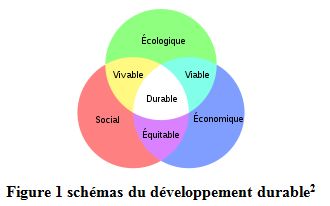
These three aspects need to be able to meet the goal of building sustainable development for both communities and businesses. In other words, the scheme should meet the following characteristics:
• Sustainable development or sustainable: the human being is at the center of economic, social and environmental. he alone is capable of acting on these tenants and allow the survival of our planet.
• Developing Livable: to take into account environmental and social factors, that is to say, to ensure acceptable living environment. This amounts to including the idea of reducing inequalities between the North and South.
• The sustainable development: it means that economic and environmental factors must be considered together, ie to allow long-term and self-sustaining economic growth based on renewable resources.
• Equitable development: the objective is to combine economic growth while respecting human rights, achieve greater equity in global trade in particular.
The challenge of implementing sustainable development is therefore to ensure that we were aiming to achieve simultaneous and balanced these three fundamental objectives in our behavior, our actions, our policies, our programs, our laws, regulations and all of our other interventions.
The implementation of these objectives relies on a number of which help us better understand the challenge they represent.
Maintain the integrity of the environment is integrated in all actions of human communities (governments, interest groups, businesses, citizens) the concern for maintaining the vitality and diversity of genes, species and entire ecosystems.
This involves measures of protection of environmental quality, management and maintenance of critical habitat for species and a sustainable management of animal and plant populations exploited.
Advancing social equity is to allow the basic needs of present and future human communities and improving the quality of life. This implies access for all to education, health care and social services, employment, decent housing, and respect the rights and freedoms, and participation for the all groups of society, the various decision-making process.
Improve economic efficiency: that promote optimal management of human, natural and financial, to enable the needs of human communities.
This means empowering businesses and consumers in relation to goods and services they produce and use, and the adoption of appropriate government policies (the principle of polluter pay, integration of environmental and social costs, taxation.
In all, sustainable development is a development process that balances the ecological, economic and social issues and establish a virtuous cycle between these three areas:
This development, economically efficient, socially equitable and ecologically sustainable. He is respectful of natural resources and ecosystems support life on earth, which ensures economic efficiency, without losing sight of the social objectives of development such as the fight against poverty, inequality and cons of equity research .
_____________________________________
(1) The Tobin tax, suggested in 1972 by Nobel laureate economist James Tobin is a tax on international currency transactions in order to create a disincentive to speculation
(2) www.wikpedia.org, patterns of sustainable development: the confluence of three concerns, saying the three pillars of sustainable development
defining sustainable development
0 commentaires:
Enregistrer un commentaire